
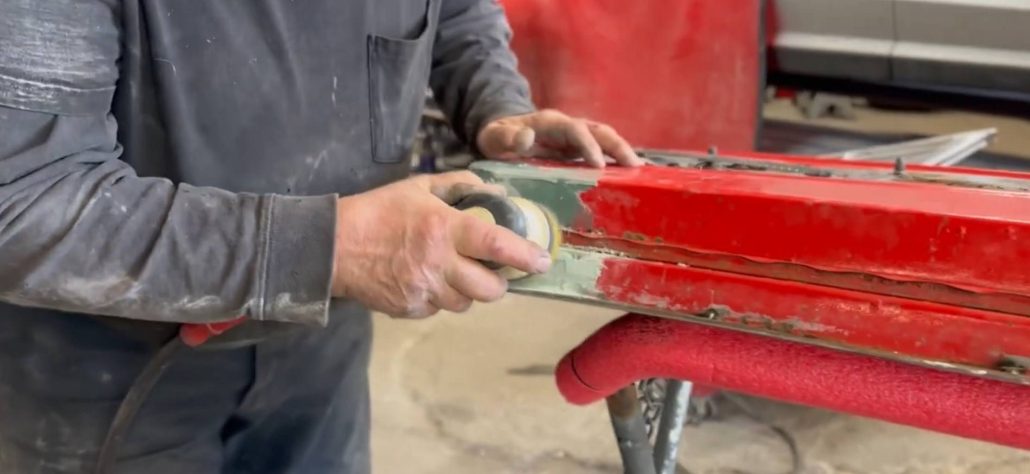
Rust on a classic Mustang door raises an important question: should you patch the appearance or repair the metal? In this episode of “If You’re Gonna Do It Wrong, Do It Right!”, master technician Steve Wepp demonstrates a cosmetic workaround on a rusted 1966 Mustang door while explaining what a proper metal repair would involve.
The proper way to repair a rusted door
Steve starts with the repair he recommends: cut out the rusted section and weld in a metal patch. That replaces the damaged metal instead of covering the hole. It is the approach to consider when the goal is a lasting metal repair.
For this demonstration, Steve takes a different route. He explains that the scope of a job does not always call for cutting and welding, so he shows how he approaches a cosmetic patch. The distinction matters: the tape and filler shown here do not replace the missing steel.
Recessing the aluminum tape
Steve places aluminum HVAC tape over the rusted opening to create a backing for the filler. The trick is to keep the tape below the surrounding surface. If it sits too high, there is no room to build the filler up to the door’s original contour.
He works the area with a hammer before applying the filler, showing how the shape underneath affects the finish on top.
Why Steve chooses fiberglass reinforced filler
Steve uses DURAGLAS, a fiberglass reinforced body filler, over the taped area. In the video, he discusses moisture as a concern around rust damage and explains why he chooses this type of filler for the demonstration.
DURAGLAS is described by its manufacturer as waterproof and suitable for certain rust-out and hole repairs. That property does not make the taped opening a welded metal repair, nor does it remove rust that remains in the door. The finished result should be understood as a cosmetic patch.
What this 1966 Mustang repair teaches
The lesson is about choosing a repair with its limitations in mind. Steve shows a way to improve the appearance of a damaged door, but he is direct about the difference between covering rust and replacing rusted metal.
- A welded metal patch replaces the rusted section.
- Aluminum tape provides backing for the cosmetic filler application shown in the video.
- Recessing the backing leaves room to shape the surface.
- Fiberglass reinforced filler does not turn a cosmetic patch into a metal repair.
Watch Steve Wepp’s 1966 Mustang door demonstration to see the process and hear his reasoning at each step. To learn more about hands-on automotive work, explore Autoseum’s automotive classes.